

Cleanroom Classifications
What Are Cleanroom Classifications (ISO 14644-1)?
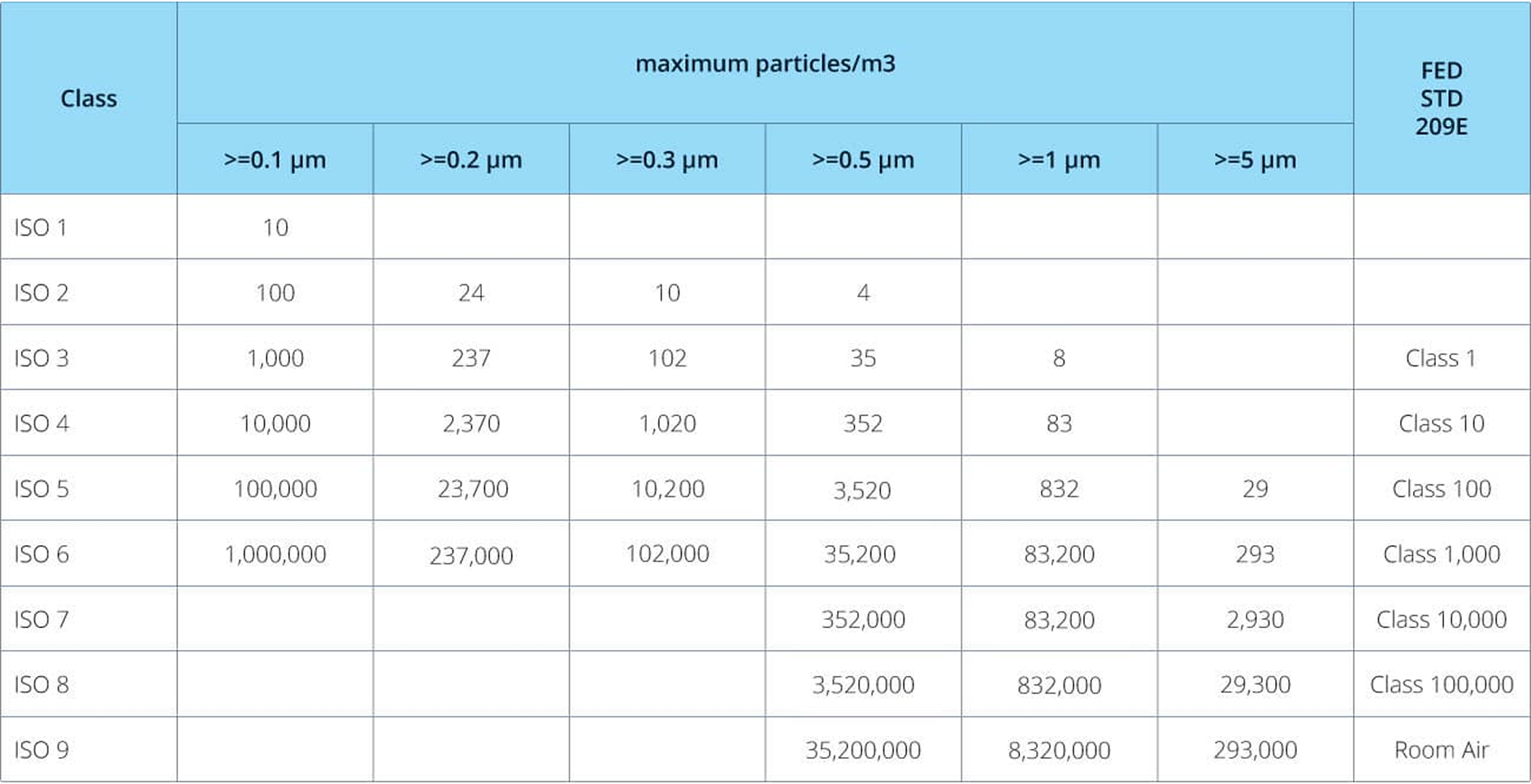
ISO cleanroom classifications are categories that outline how clean a controlled environment is. They run from ISO 1 to ISO 9, and are determined by the number and size of particles present per cubic meter of air. They are set by the ISO 14644 standard, and the section called ISO 14644-1 specifically defines the categories.
Cleanroom Classification Systems in General
Cleanroom classifications in general are defined by standards that specify allowable airborne particle concentrations. Today, the main classification system in use around the world is ISO 14644-1.
An older standard, Federal Standard 209E (FED-STD-209E), is still sometimes referenced in some industries, but has largely been replaced by ISO. Other industry standards and regulations (such as GMP or USP) do not define cleanroom classes themselves, but instead reference ISO classifications as part of broader requirements.
Differences Between ISO Cleanroom Classes
To show how ISO classifications differ, let’s start by taking the air quality in a typical urban city. The air here typically has 35,000,000 particles per cubic meter, each of which is 0.5 μm (μm = micrometer) or larger. This area would be classified as ISO 9, which is not necessarily a cleanroom, but is the category associated with normal air.
At the other end of the spectrum, there are ISO 1 cleanrooms, which allow no more than 10 particles per cubic meter that are 0.1 μm or larger, and only 2 particles that are 0.2 μm or larger. This type of space, as you may well imagine, is difficult to create (and especially to sustain). A simple scratching of the head or sneeze can significantly affect the work being done.
Finally, let’s consider an ISO 5 cleanroom, which seems to be in the “middle” between 1 and 9 (though technically, this is still a very strict space). These environments only permit 100,000 particles per cubic meter at 0.1 µm, while an ISO 4 cleanroom, which is even stricter, permits up to 10,000 particles per cubic meter of the same size.
Notice that the number of particles differs by one order of magnitude, so even though ISO 4 and ISO 5 are only one number apart, a lot more effort will have to go into building the former than the latter.
All this goes to show that there can be big differences in requirements, features, and costs between classes that differ by only one or two levels.
An Overview of ISO Cleanroom Classifications
- ISO Class 1: This is the strictest classification. It is also very rare, and not often needed except for the most uncompromising applications, such as nanotechnology, advanced semiconductor research, or life sciences. It allows no more than 10 particles ≥0.1 µm and 2 particles ≥0.2 µm per cubic meter of air.
- ISO Class 2: These environments are also exceedingly rare. They’re used for similar applications as ISO 1, but with slightly more tolerance. This classification is still driven by particle counts below 0.5 µm, rather than larger particle sizes.
- ISO Class 3: This classification is still relatively rare in the real world, but much more common than ISO 1 or ISO 2. They may be used in advanced semiconductor processes, nanofabrication, or metrology. Particle control below 0.5 µm remains the most important concern, with limits well under 1,000 particles per cubic meter.
- ISO Class 4: These environments are much more common than the above. They are still considered very strict spaces, but there is less emphasis on controlling ultrafine particles. Some common applications include semiconductor manufacturing, optics, and research and development. Particle control below 0.5 µm is still the focus, but counts move into the thousands per cubic meter.
- ISO Class 5: These spaces are common in many industries, especially for pharmaceuticals, biotechnology, medical devices, and semiconductor work. At this level, particle control is focused primarily on 0.5 µm and larger particles, with allowable counts in the low thousands per cubic meter.
- ISO Class 6: ISO 6 spaces are common, and are used in many manufacturing contexts. Typical applications include electronics, pharmaceuticals, medical devices, aerospace, and more. Particle control is focused on 0.5 µm and larger particles, with allowable counts in the tens of thousands per cubic meter.
- ISO Class 7: These, along with ISO 8 spaces, are perhaps the most common of all. They are often used as buffer zones in pharmaceuticals, for assembly and packaging, and other support areas. Though still much cleaner than outside urban air, control is mostly focused on larger particles, with allowable counts in the hundreds of thousands per cubic meter.
- ISO Class 8: These environments are much less strict, and are generally used for things like general manufacturing, gowning rooms, packaging, and other staging spaces. ISO 8 cleanrooms are common in pharmaceuticals, medical devices, electronics, and food and beverage production. Particle control is primarily concerned with larger particles, with allowable counts in the millions per cubic meter.
- ISO Class 9: In practice, ISO 9 is rarely treated as a cleanroom. It represents typical indoor air conditions and is generally used as a reference point rather than a controlled environment.
How Particle Counts Work in Classifications
Take a look again at the ISO 14644-1 cleanroom classifications table. You may notice that some ISO classes do not include certain particle sizes. For example, ISO 8 cleanrooms don’t measure sizes 0.1 µm and larger, ISO 3 cleanrooms don’t measure sizes 5 µm and larger, and so on.
This is for two main reasons. First of all, the number of particles in a particular size range may be too high to measure. In other words, there may be so many particles of a particular size that trying to measure them would be difficult if not meaningless.
Secondly, for each cleanroom class, there are only a handful of particle sizes that are focused on, and the reason for this is that those are the sizes that cause the most problems to the work being done within the space. In pharmaceutical cleanrooms, for example, particles that are 0.5 μm or bigger may bring microorganisms with them, which of course may contaminate medicines. As a result, these need to be prevented from entering the most.
Furthermore, you may also notice that the maximum particle counts in cleanroom classification are cumulative, since they include particles that are bigger than the defined size. All this means is that sometimes particles will be counted in multiple categories.
Here are a couple examples of how this works:
- If a particle is 2 μm, it needs to be included in the count for particles 2 μm or greater. But, it is also counted again in the categories that are smaller than 2 μm (where relevant).
- In the same way, a particle that is 5 μm is counted both in the group for particles 5 μm and larger, and also counted in the successively smaller categories.
In short, a single particle is often counted multiple times.
What is Federal Standard 209E (FED-STD-209E)?
Historically, the Federal Standard 209E was the go-to classification system. It categorized cleanrooms based on the size and number of particles per cubic foot of air, rather than per cubic meter, as is the case with ISO classifications.
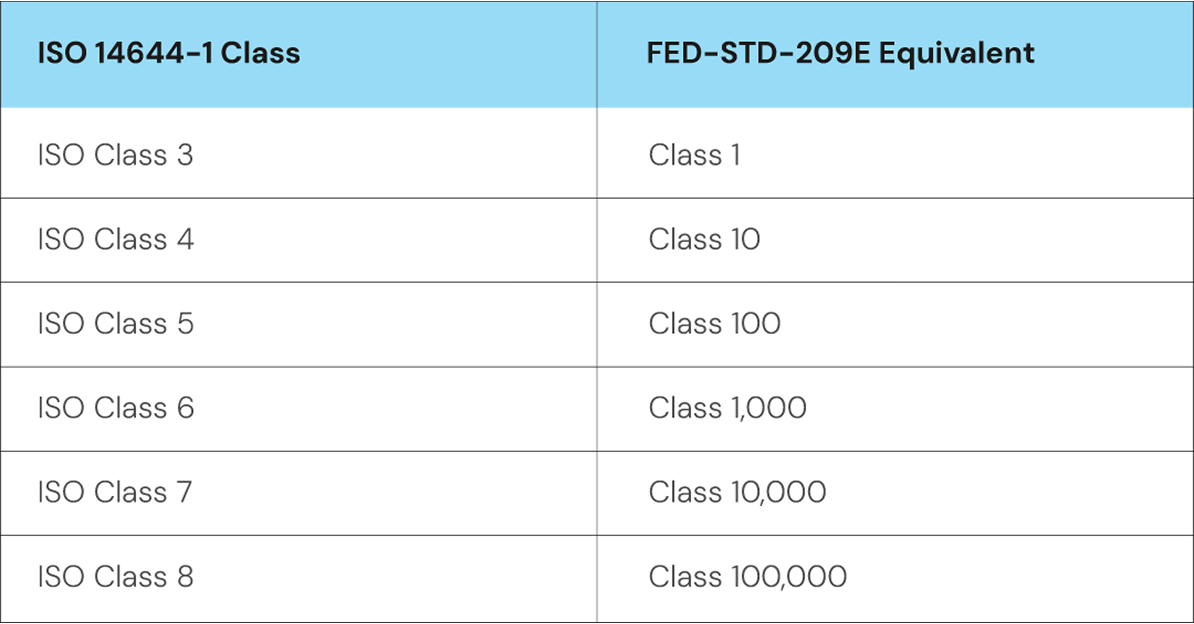
In 2001, however, the Federal Standard 209E was replaced by the ISO 14644-1 standard. The language has not been fully carried over yet, though, and terms like “Class 10,000” or “Class 1,000” are still used today.
Also, if you take a look at the table below, you may notice that the ISO classes are equivalent with classes in FED-STD-209E, and this explains why these terms are so often used interchangeably.
ISO 14644-1 and FED-STD-209E Class Equivalents
FAQs About ISO Cleanroom Classifications
How are cleanroom classifications verified?
Testing and certification are done using particle counters, airflow measurements, and other environmental monitoring. Such tests are performed both “at-rest,” which means without staff present but including equipment, and “in operation,” which includes staff and equipment.
Can a cleanroom meet more than one ISO class?
Technically, yes. In fact, a cleanroom with multiple rooms or zones that have different classifications is quite common. In many of these spaces, you progressively work your way from an ISO 7/ISO 8 space to stricter ones, such as an ISO 5, where the most important work happens. The other rooms may serve as buffer rooms, gowning rooms, or anterooms.
Do ISO cleanroom classifications cover microbial contamination as well?
No, ISO 14644-1 only focuses on non-viable (non-living) particle counts. The control of microorganisms is covered in other industry standards, such as cGMP and USP 797.

Leave Your Cleanroom in Expert Hands
- 35+ years of experience
- Compliance for ISO, FDA, cGMP, USP, and many other standards
- Coast-to-coast service
- All design, engineering, and production done in-house